Structured literacy and whole language should be pals
For this to make any sense you first need to know I’m an intermediate school teacher. Also the whole post is quite formal and long and schooly and definitely not everyone’s cup of tea.
Also please note all the names are fakes (obviously).
Introduction
Aotearoa NZ has a new English curriculum that emphasises a teaching approach called ‘Structured literacy’. Simply put, this is about teaching reading and writing through the explicit and sequential coverage of various specific bits of language, e.g. letter–sound relationships, syllables, morphemes, vocabulary, sentence structure etc. In the past the English curriculum focussed more on a method called ‘Whole language’. Again simply put, this is the idea that children can learn to read and write through experience and engagement, e.g. with literature and other types of texts, and personal activity, knowledge and expression.
There are passionate adherents to both Structured literacy and Whole language. And these educators, theorists, politicians and parents will often ferociously pit them against each other, declaring their favourite to be the one true answer to the country’s literacy achievement woes and the other a failed and dangerous philosophy. I think this is daft. I think the technicality of Structured literacy and the conceptualism of Whole language are both valuable, and should be used in whatever way best meets the needs of the student and/or class and/or situation. I also think they’re complimentary - pedagogical pals - and that often you succeed the best when you use both at the same time.
This post is about a time a colleague and I did just that and the results we achieved. It’s essentially a case study in meeting the writing needs of a specific learner and how we used Structured literacy and Whole language to do so.
This post is organised as follows:
- About Lucy (who’s not really Lucy)
- Working with Sally (who’s not really Sally)
- Case study context - genre
- Indicators of success
- Why it worked
- Conclusion
About Lucy
Lucy is a year seven student. She was a selective mute until year five and spoke very rarely and quietly when she arrived in my class. She was also shy, isolated and lacking in confidence. In her reading comprehension PAT Lucy scored stanine 1. In the writing PAT her piece was too short and confusing for the software to assess. Because of these results and her learning background generally, she was referred to my learning support colleague, Sally.
Working with Sally
Sally and I shared the same goals for Lucy. They were to:
- Improve her writing confidence, enjoyment, knowledge, skill and achievement; and
- Provide her with strategies and opportunities to use new knowledge and skill, consolidate learning, and therefore increase confidence, enjoyment and achievement
In working to achieve these Sally and I employed some common strategies and some that were different but complimentary. We focused on different aspects of writing which when merged created rich learning experiences for Lucy.
Essentially Sally withdrew Lucy and worked with her using a classic Structured literacy approach. Together they looked at phonics, parts of words, their uses and construction, vocabulary etc. And Lucy absolutely needed to do all of this. Back in the classroom I provided contexts within which she could apply and expand on her learning. These emphasised literary forms, features, purposes, and social and cultural influences; a typical Whole language environment. Lucy also needed this.
Case study context - genre
In Term one of this year our class writing focus was ‘genre’. I spent a lengthy period of time scaffolding the concept with the students before asking them to write their own genre stories. This involved definitions of genre, genre and sub-genre types, genre vs form vs format, tropes, vocabulary, settings, characters, images, events, authors, histories, text features, story shapes, and social and cultural contexts specific to different genres.
The learning intention was,
We are exploring the elements of different genres - both content and form - and using what we learn to write our own interesting, impactful and authentic genre stories.
(Mostly I’m not a fan of learning intentions. For me they make teaching too much like service delivery. When I’m forced to use them I make them deliberately ambiguous. I talk more about this later in the post).
Sally and Lucy’s structured literacy work occurred alongside this broader writing context.
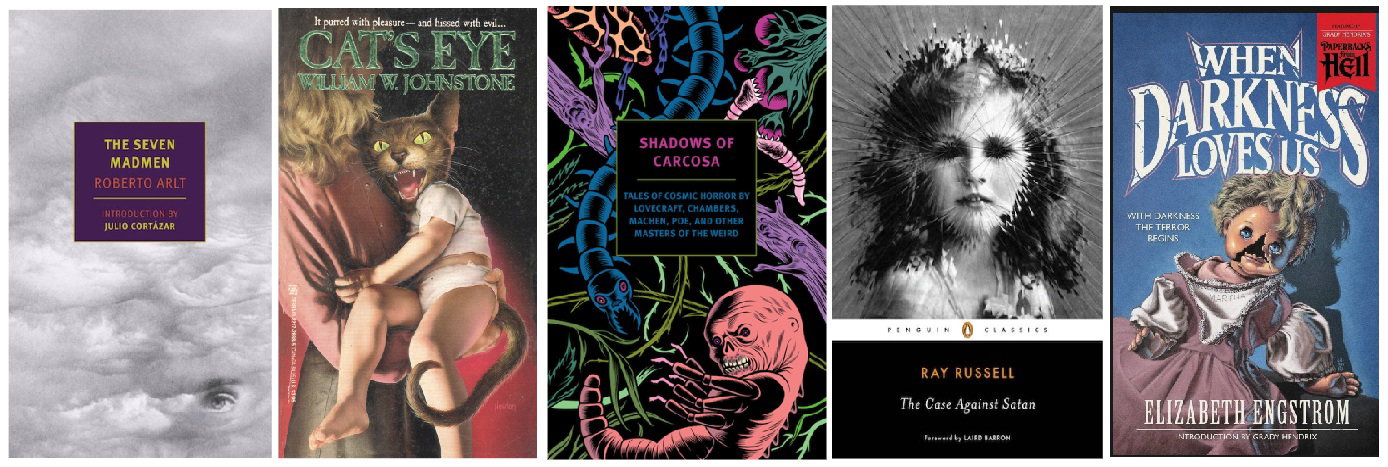
As part of exploring 'genre' we looked at book covers including these ones for horror novels.
Indicators of success
Lucy’s writing improved!
There were three main pieces of evidence for this. They were:
- Her test scores
- The writing she produced
- Her emotional response
Test scores
In February of this year Sally’s testing showed Lucy to have a reading age of 7.5 and spelling age of 7.1. By April she’d moved to 7.7 in reading and 7.8 in spelling. In eight weeks this was a significant shift.
The writing she produced
Lucy chose to write in the horror genre. Called ABANDONED (her capitals) the first paragraph of her final draft - written unaided - was this,
In the moring there was a girl and she had a friend they tack and play and laugh together but one day her friend look scared and she said to her friend wath happened and her friend said last night when I was watching tv there was a news about a ABANDONED house and there is gost living there and a creepy girl and scaer people woau try to get in and we hear scratch and screaming and a creepy laugh. (Below the footnotes is the whole story. It's a good read!)
On the second draft Lucy and I worked together. We focussed on structured literacy-type things like punctuation and spelling(this was more than enough for her to manage). Then I ‘repaired’ the rest of the text, explaining to Lucy the changes I’d made and checking she was OK with them. Here's the same part after this process,
There was a girl and she had a friend. They talked and played and laughed together but one day her friend looked scared. The girl said, “what happened?”
Her friend said, “last night when I was watching TV there was news about an ABANDONED house and a ghost is living there and a creepy girl and they scare people. They try to get in, and hear scratching and screaming and a creepy laugh”.
As you can see in the first version Lucy had significant difficulties with syntax and other technical aspects of writing. (It was however a substantial improvement on her PAT piece. ABANDONED was longer with a larger vocabulary and improved spelling).
In the second version of ABANDONED, once all the corrections were made, it also became clear that Lucy had an understanding of the classic horror genre. For example her story included:
- Words like ‘scared’, ‘creepy’ and ‘abandoned’
- Settings like an abandoned house
- Characters like a ghost and a creepy girl
- Actions like friends sneaking into a scary abandoned house
- An ending where the protagonist turns into the creepy doll she’s initially so afraid of (classic!)
Most impressive was Lucy’s use of capitals in the title ABANDONED. This was an intentional decision on her part, a feature deliberately designed for impact and maintained throughout the story. It illustrated a knowledge of text conventions and references (i.e. a word entirely in capital letters stands out and is something significant) and an understanding of the relationship between form and content (i.e. in combination they can create new meaning). Lucy was one of the few students to use a language feature of this type and the others who did were mostly at the highly-skilled end of the writing spectrum.
It is important to note that when working with Lucy on her draft story I deliberately didn’t engage on any genre or content elements. This stuff was all her own knowledge, understanding and enacting.
Her emotional response
For both Sally and I, Lucy’s changing emotional response to writing was perhaps the most important indicator of her success. When she read ABANDONED to Sally you could see the enjoyment and pride. Lucy was beaming and she held her head up high. As teachers this is the stuff we live for.
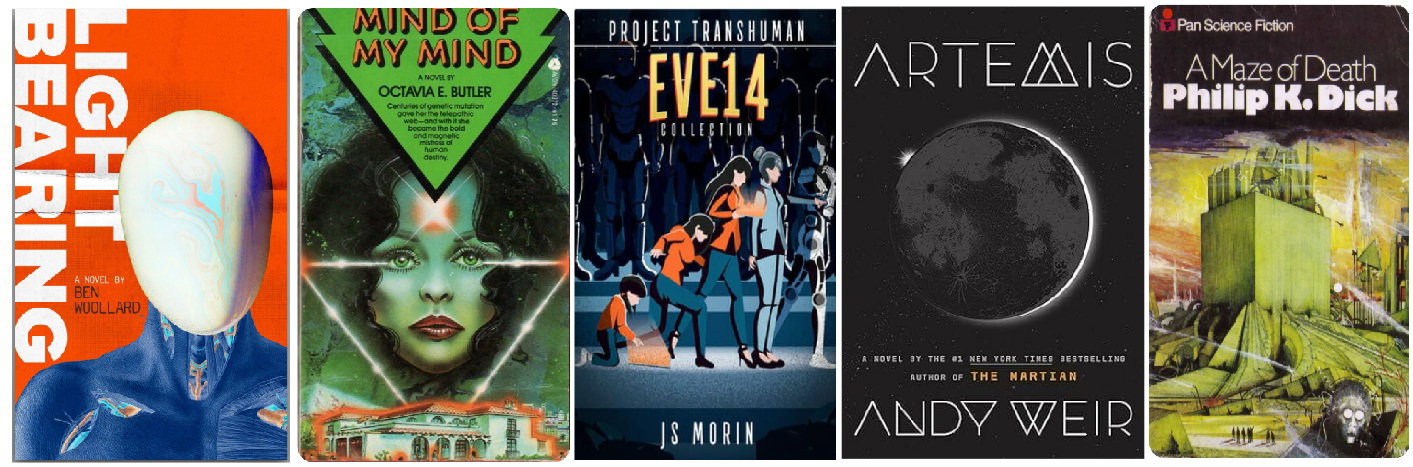
As part of exploring 'genre' we looked at book covers including these ones for science fiction.
Why it worked
Sally and I used a variety of strategies - from Structured literacy, Whole language and just good practice generally - to support Lucy in achieving her writing success. Some of the most significant were:
- A firm belief in her desire, potential and ability to learn
- An initial emphasis on relationship-building and making her feel safe
- An ongoing emphasis on strengthening her confidence via feedback, positive reinforcement and ‘just right’ challenges
- A simultaneous focus on technical writing components (Sally) and broader literacy understandings and contexts (me) with easy transitions back and forth, and opportunities for Lucy to genuinely participate in both
- Professional respect between Sally and I and the collaborative use of our respective expertise
- An intentionally ambiguous genre-related learning intention
- A commitment to maintaining Lucy’s dignity
I’m going to talk further about these last two points.
An intentionally ambiguous genre-related learning intention
Here’s the learning intention again,
We are exploring the elements of different genres - in both content and form - and using what we learn to write our own interesting, impactful and authentic genre stories.
It's intentionally ambiguous. For example using ‘content and form’ rather than ‘setting, themes, characters, sentence types, word count etc.’ and 'exploring' rather than 'mastering' or 'learning to'.
Ambiguity of this type inherently provides for differentiation. That is, space for:
- Learners to make their own choices, i.e. what ‘content and form’ might mean in the context of their own work. (I do want to reiterate the important and extensive period of genre-related teaching and learning to support the learning intention. It gave students the confidence and ability to make informed choices).2
- Students to work at their own level. Lucy was catered for, but so too were skilled and confident writers. (Below the footnotes and below Lucy's story is an example of one of these, 'The Clock Struck One' by Marcie (who's not really Marcie). It's a complex, sophisticated piece of psychological horror and another great read).
A commitment to maintaining Lucy’s dignity3
For both Sally and I, maintaining the dignity of any learner is crucial. For Lucy this meant the right to refuse withdrawal from class (she never did, she adored Sally) and a corresponding right to go every time she had the opportunity (whatever was going on in the classroom. Even if it was…gasp…maths). Lucy could also leave without any fuss, no need to pack up her desk or ask my permission or wear the gigantic, bright blue out-of-class pass.
Maintaining her dignity also meant Lucy had the same learning experiences and expectations as everyone else. She didn’t have to sit with me at the front or work in any ‘special’ way or look at junior readers when the rest of us were exploring HP Lovecraft. She did receive extra support but it was provided discreetly, e.g. stopping at her desk more often, giving her a slightly longer conference time, bookmarking a suitable internet dictionary on her device etc. But mostly Lucy was just a year seven kid working alongside other year seven kids.
Conclusion
Sally and I helped Lucy get better at writing and we used elements from both Structured literacy and Whole language to do it. They're both useful and the education as we know it did not explode.
Footnotes
2. So by the time they came to write their own stories, students knew for example, that choosing to create an action-based horror meant an emphasis on story pace, heroes and villains, surprise, and some kind of violence. Whereas choosing a psychological horror meant a slow, suspenseful build-up, strong character development, and high emotion.
3. See the following for research on the connection between learner dignity and achievement, Dignity in Education part 1 (Psychology Today) How Can Schools Create A Culture of Dignity? (Schools of Character), PB4L restorative practice (NZ Ministry of Education)
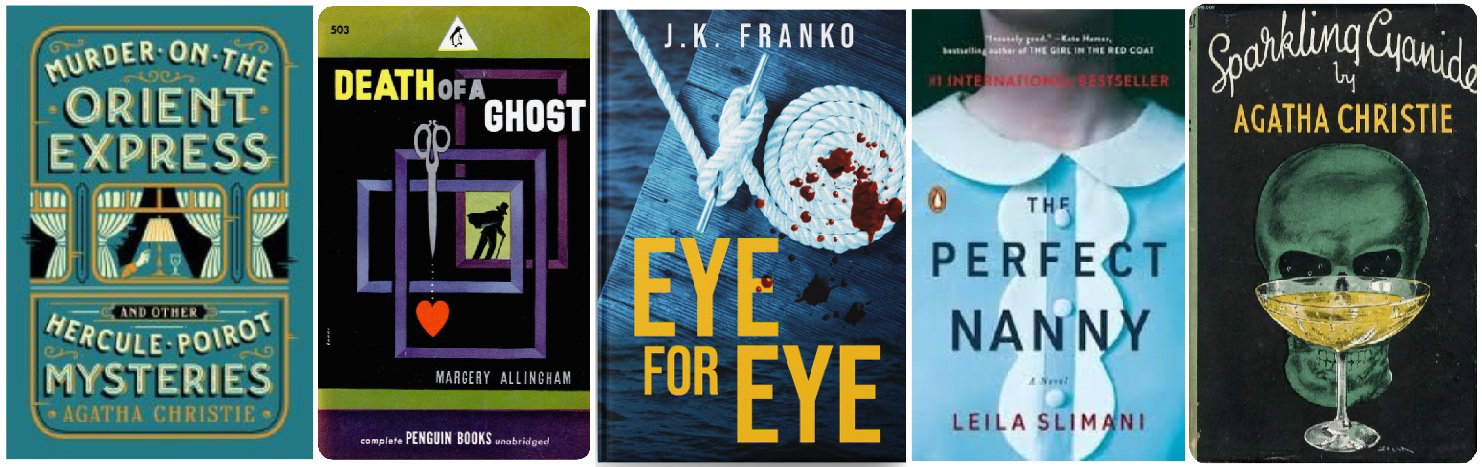
As part of exploring 'genre' we looked at book covers including these ones for mystery novels.
ABANDONED by Lucy
There was a girl and she had a friend. They talked and played and laughed together but one day her friend looked scared. The girl said, “what happened?” Her friend said, “last night when I was watching TV there was news about an ABANDONED house and a ghost is living there and a creepy girl and they scare people. They try to get in, and hear scratching and screaming and a creepy laugh”.
Her friend said that we should have a sleep over and she said, “OK let’s go”. So they went and they had so much fun. When it was sleep time her friend went to sleep but she was scared so she went outside for air. She had in her mind to go to the ABANDONED house and look, so she went.
She walked and walked and then she found it. So she slowly walked into the ABANDONED house and looked inside. She saw spiderwebs and heard a breaking door and breacking glass. She saw the creepy girl and the creepy girl looked at her and took her!
In the morning the people looked for her but they couldn’t find her. Now she has become the creepy girl in the ABANDONED house.
The clock struck one by Marcie
I looked up at the huge clock on the wall, counting each tick with a sigh. My brain was empty, except for the feeling of pain and grief. I didn’t know why I was upset, where I was, who I was. I only knew that I was looking at an old, detailed clock in a dark room full of antiques.
On one wall there was a shelf that displayed a vase full of withered roses and a single, unlit candle. There was a bookcase full of thick, leather-bound books that were covered in dust. They had thin, gold writing on the covers, each saying something in a language I didn’t understand. Beneath my black shoes was a brown rug with an unusual pattern. It felt soft and woolen to the touch, but looked like the kind of material used for towels. The whole room reminded me of a thrift store that old people go to.
As I counted each tick of the gold clock, memories started flooding my head. It was overwhelmingly beautiful yet chaotic and horrifying at the same time.
The clock struck one.
My hands were red and covered in cuts. I could feel the pain like I was there. Was I there? I didn’t know the answer to a lot of things, let alone memories that don’t feel like mine. I looked down at my shoes; they were covered in mud and the soles were falling apart. There were a pair of shattered glasses on the earth in front of me, lying on a bed of fallen branches.
I looked around. I seemed to be in some sort of forest. There was an abandoned cottage with broken windows and vines growing through it– even a tree growing out of the roof!
I spun around as I heard a twig snap behind me. Cliche. I thought to myself. Stumbling through the dark, I made my way to a bush with unnaturally red berries that were obviously poisonous. Not like I was going to eat them anyways. A pair of scratched antlers emerged from the bush, and guessing by the size of them they were from a huge stag. My stomach rumbled loudly. I was starving and alone in a forest that looked like no one had been there for decades.
I reached my arm out and tugged on the antlers, surprised when a deer skull lifted out of the bush. No food for me… I sighed, wishing I was back in the antique room and staring at that golden clock as years went by. Truth is, I didn’t even know how long I’d been there. All I know is that I was once in a room, and now I’m in a forest. A deep, dark forest.
Hungry, I decided to go back to the abandoned cabin for shelter and in hopes of starting a fire. Fire could lead civilization to me, and civilization meant food and clean water.
I turned around, jumping back when I saw blind, lifeless eyes staring back at me. I took a step backwards, trying to see exactly what I was dealing with.
The creature was tall and had all of its bones showing. With a pale bony hand, it snatched the skull from me and fastened it to its head. It tilted its head as if to study me, as if to get to know me. I took a deep breath and started walking past it, trying my best not to be scared.
I felt something cold grab my arm tightly. Instinctively, I checked my watch for the time. 01:58. As a minute passed, I found myself back in the thrifty room and sitting on the ugly leather sofa. I gazed at the golden clock once more.
The clock struck two.
I was sitting on the floor of a tunnel, my legs crossed against the cold, hard concrete. The lights flickered above me as if I were in a horror movie. There was mold on the ceiling, cracks in the wall, and the sparks flew from the light above me. The tunnel went black as the lights went out. I stood up, feeling around for the wall.
Cursing under my breath, I stumbled through the tunnel blindly as I fought the foolish urge to shout ‘Marco!’ Pain shot through my body when I smashed into the concrete wall. For a split second, the lights turned on around me. Before the lights turned off again, I caught a glimpse of a tall, hunched over creature with long antlers.
“Hello?” The echo of my voice cracked with fear.
“Hello, human…” came the beastly reply.
I took a step backwards into the darkness only to walk into something hard. Something clamped its hands—or claws—around my neck and lifted me off of the ground slowly. My breaths came in short, wheezy gasps. The lights were now turning off and on repeatedly. I finally looked down at the ground, which was at least a meter below me, and at the deranged shadow. I could make out the antlers clearly, but the rest of it was just a huge, bony shape.
I checked the watch once more, somehow relieved to see it say 02:49. Pm or am, I wasn’t entirely sure.
Suddenly, I hit the floor with a sickening thud that sounded like bones cracking. My ears were ringing high pitched and my legs felt like they couldn’t move. Using my hands and arms, I clawed my way across the ground. My throat felt like sandpaper.
Once more, I checked my watch. 02:50. I closed my eyes for a second, and when I opened them I was back in the clock room.
The pain had faded and my legs felt fine but I had a huge scar across my arm. I turned my focus away from the clock and onto the vintage bookshelf. I grabbed the first book I saw and collapsed onto the leather sofa.
The book’s cover was dark blue and had a bit of wear-and-tear. Without reading the title, I skipped to a random page in the middle of the book.
What to do when stuck somewhere with no civilization.
1. Find shelter, a source of food, and a source of clean drinking water. Note that you can survive several weeks without food, but only a few days without water.
2. Once you have water and food nearby, set up your camp. Not too close to the water source though, because of wild animals having a drink.
I flipped through the pages absentmindedly. I already knew how to survive in the wild! I wasn’t sure how I knew this, but I did. I flicked through the pages, stopping at one with a detailed illustration. The image was the silhouette of a huge beast. It had what looked like horns and its spine was visible. I knew this was what I was looking for.
How to survive with the Deerdevil nearby (note that it isn’t scientifically called the Deerdevil, this was just a play on words).
1. Remember that it follows you everywhere, so don’t be surprised if you see it miles from where you saw it last.
2. There’s no point in hiding since it has an incredible sense of smell and hearing. Sight is its weakest sense, so use that to your advantage.
3. Try to set out traps to catch it. You are not strong enough to defeat it alone, so it may be wise to bring multiple people along with you.
4. It does its best to haunt you rather than kill you. Use that to your advantage.
5. If all goes wrong, remember that there is no true way to kill it. It will haunt you for the rest of your life until you are driven insane.
My excitement was swiftly replaced with a looming dread. I slammed the book shut and turned my attention back to the clock once more.
The clock struck three.
I woke up in a cave, feeling down. I slumped against the stone, crossing my arms over my chest like a grumpy teenager. Lightning flashed outside, illuminating the darkness for a heartbeat. I didn’t bother freaking out when I saw the shadow of a monstrous beast. I simply sulked even harder than before.
I closed my eyes and saw a memory flash in my mind. My consciousness reached out and gripped the memory before it drifted away into the sea of dread forever.
“Mike! You are impossible!” a crying woman shouted at what appeared to be her husband.
“I’m telling you, Morgan, I know what I saw!” Mike yelled back in disbelief.
“A huge beast with antlers? That was a weird pink-grey colour and walked on two legs? You’re imagining things, Mike!” Morgan sniffed.
Mike shook his head. “The kids believe me,” he muttered. His eyebrows were furrowed with anger.
“Don’t bring the kids into this! You’re just having some strange, recurring nightmare about a deer. You’re probably remembering it wrong, too.” Morgan added as Mike opened his mouth to speak.
I remembered Morgan. I remember this scene, but not any of the dialogue from it. I feel like this is related to me, somehow.
“Mike. Are you having flashbacks of your past? Morgan hated that golden clock of yours.”
That’s when I realised. That strange antique room— that was my office. I bought the clock and I painted it gold even though I hated it, like Morgan.I heard the sound of a clock, getting louder and louder. Then a bell chiming, which meant it was midnight or something like that.
Chime!
A dark alleyway. I was cornered by something with glowy eyes and it walked on two legs.
Chime!
A bite mark in my leg. The holes went deep into my flesh.
Chime!
Police sirens ran through my ears as I was running from something that lumbered heavily behind me.
Chime!
Screams. My hands were shaking.
Chime!
The last scene. Flashes, sinking into water, guilt.
“Mike. You know this is the end.”
I nodded, solemnly accepting my fate.
“Good. You’ve let yourself go insane, you’ve prioritised your nightmares and your fear over your family. Over your life, over your sanity.”
I sighed, knowing the beast was right. I remembered everything, all the fights and all the times I lay on the couch and wondered what I was doing with my life.
“Mike, you had talent. You threw it all away over what Morgan said was a fever dream. You were selfish, you were scared. Now it’s time for you to rest. Close your eyes, Mike.”
I did as I was told and closed my tired eyes. I couldn’t remember the last time I slept. I felt peace for the first time in years.
“Goodbye, Mike. You were good.”